
The second wave of the pandemic in the country has derailed the recovery momentum of the domestic auto industry, which was poised for a comeback in the current fiscal after witnessing the two consecutive challenging years, ratings agency ICRA said on Thursday. Unlike the first wave where infections were largely localised to urban clusters, the second wave has seen deeper and wider penetration, including into rural hinterlands. Accordingly, outlook for various segments has been revised downwards, it said.

'It appears the growth rate could be around six per cent'.

The Reserve Bank of India on Thursday kept the benchmark interest rate unchanged at 4 per cent and decided to continue with its accommodative stance against the backdrop of an elevated level of inflation.

To enable widen the fiscal deficit beyond the permissible limit under the present legislation, the government may have to propose amendment to the FRBM Act in the Finance Bill.

However, the SBI report said it will take almost seven-quarters from Q4 FY21 to reach the pre-pandemic level in nominal terms and there will be a permanent output loss of around 9 per cent of GDP.

The mop-up could have been much higher, but tax on imports fell 2 per cent y-o-y.
ITC has been one of the best performing large-cap stock at the bourses thus far in calendar year 2022 (CY22), rallying nearly 52 per cent during this period and outperforming the sector benchmark - the S&P BSE FMCG index - by a wide margin that moved up around 17 per cent during this period. However, the counter has lost over 5 per cent from its recent high of Rs 346.25 hit on September 23, 2022 and has underperformed the S&P BSE Sensex, which has lost nearly 2 per cent since then. So, is the rally in the stock coming to an end, and is this a good time to book profit?
A well-established tax system would have a predictable buoyancy - how fast the collections grow as a proportion to the growth of the economy. But that is not the case with GST. It is still undergoing substantial changes as the government responds to structural as well as administrative glitches.

'The numbers are null and void now. Look, we can give out projections now, but we know that a week later those numbers will also be irrelevant. So we need to wait,' a top government official said.

The International Monetary Fund (IMF) on Tuesday slashed India's growth forecast for 2022-23 (FY23) by 80 basis points to 7.4 per cent, citing less favourable external conditions and rapid policy tightening by the central bank. In its update to the April World Economic Outlook, the IMF said that though a global recession in 2022 was ruled out with a growth estimate of 3.2 per cent, the balance of risks was squarely to the downside, driven by a wide range of factors that could adversely affect the global economic performance. "The risk of recession is particularly prominent in 2023, when in several economies growth is expected to bottom out, household savings accumulated during the pandemic will have declined, and even small shocks could cause economies to stall.

The Delhi high court on Tuesday said that economic interests cannot override human lives and in view of various hospitals in the national capital running low on oxygen, the Centre should immediately implement the ban on industrial use of oxygen instead of waiting till April 22.

The cost of debt-funds for the states has touched the highest level so far this fiscal with the weighted average cut-off crossing the 7.16 percentage points at the latest auctions, up 11 bps over the past week, reflecting the hardening yields even for the government securities. The hardening of the rates at the first auction of the quarter comes in the wake of the expected large supply of debt from the states, as indicated for Q4 at Rs 3.2 lakh crore, up by Rs 10,000 crore. Nine states on Tuesday raised Rs 18,900 crore at the latest auction of state development loans.
The major thrust is towards Technical and Economic Cooperation.

Announcing a Re 1 crop insurance scheme for farmers, the deputy CM said the government will bear the financial burden of Rs 3,312 crore.

The country's GDP is likely to grow at 1.3 per cent in the fourth quarter of 2020-21 and may see a contraction of around 7.3 per cent for the full financial year, according to an SBI research report 'Ecowrap'. The e-National Statistical Office (NSO) will release the GDP estimates for the March 2021 quarter and provisional annual estimates for the year 2020-21 on May 31. "Based on our 'nowcasting model', the forecasted GDP growth for Q4 would be around 1.3 per cent (with downward bias) as against NSO (National Statistical Office) projection of a negative (-)1 per cent," the research report said.

The e-filing of returns in FY14 saw an increase of 40 per cent with 25.6 million online returns being filed till March 22, compared with 18 million a year ago.

Ratings agency ICRA on Wednesday revised downwards growth forecast for the domestic passenger vehicles industry to 8-11 per cent in the ongoing fiscal from the earlier estimate of 14-17 per cent on account of the ongoing semiconductor shortage. Similarly, for the two-wheeler segment, it said the volumes are expected to contract by 1-4 per cent in FY2022 against an earlier prediction of 6-8 per cent growth as affordability and demand sentiments of target clientele was hit sharply by the second wave of COVID-19 pandemic. With around 5 lakh units of production lost by various automakers in the passenger vehicles segment due to the semiconductor shortage, ICRA said the earnings loss for the OEMs (Original Equipment Manufacturers) could be around Rs 1,800 crore to Rs 2,000 crore for the ongoing fiscal.
HDFC Bank Q4 review: HDFC Bank's January-March quarter (Q4) results, for financial year 2022-23 (FY23), brought no cheer to investors as elevated costs, and merger-related uncertainties continue to dent the sentiment. Moreover, analysts fear that merger-related costs may put pressure on margins and cost to income ratio in the near-term, while the return on equity could moderate owing to low leverage of the parent. Analysts, therefore, opine that the stock's re-rating may be some time away. "While the risk of a de-rating on a standalone basis appears to be quite low given that the business performance is holding up well, we believe a re-rating in the stock would happen as and when more clarity emerges on the smooth transition (merger)," said a report by Sharekhan.

The 14th Finance Commission had recommended that states' share in the divisible tax pool be raised to 42 per cent, from 32 per cent earlier.

Starting today, Modi and top officials in the Prime Minister's Office will be briefed by various central ministries and departments on their plans as well as agenda for the next five years. They will also apprise the PMO of the work they have done so far in realising the agenda of government's second term in office.
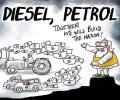
The Centre has garnered around Rs 2,500-3,000 crore in the first five weeks after it imposed a windfall tax on oil and gas companies for the export of fuel, Business Standard has learnt. It is likely that the government will continue with the one-time tax till the Indian crude basket is above $80 a barrel, sources said. The next review of the windfall tax on oil companies is early next week.

In the last fiscal, the government had originally budgeted a dividend income of Rs 27,178 crore (Rs 271.78 billion) from PSUs.

As part of efforts to boost revenue collection, CBDT has asked the Income Tax Department to monitor cases of over five lakh taxpayers who have not filed their latest tax returns.

The Organization of the Petroleum Exporting Countries (Opec) and its partners, such as Russia, collectively termed Opec+, have decided to cut crude oil production by 100,000 barrels per day (bpd) from October onwards, at a meeting on Monday. In a step that may increase prices in India, the group has decided to reduce output quotas for October, after a fall in global oil demand outlook. The cut in output is equal to 0.1 per cent of global supply.

While experts pointed out the impact of corporation tax cuts cannot yet figure in collections as most companies are yet to decide on their choice, government officials said a part reason for slow collection is the tax cut.

The government should not go in for an 'aggressive fiscal consolidation' in the upcoming Budget as global risks have not abated, RBI Monetary Policy Committee (MPC) Member Ashima Goyal said on Wednesday. Goyal further said subsidies are expected to come down as food and energy inflation moderates. WPI inflation in food articles in November was 1.07 per cent against 8.33 per cent in the previous month.

Goyal is expected to discuss the targets for the banks for 2019-20, as well as priority sector lending, recovery on non-performing assets, and the bankruptcy proceedings of various companies, which owe money to the banks.

At present, bank depositors get an insurance cover of Rs 1 lakh on their amount by the Deposit Insurance and credit Guarantee Corporation.

The appointment of new expenditure secretary comes a month-and-a-half ahead of the Budget for 2020-21 to be presented on February 1.

India's economic growth is now 'extremely fragile' and needs all the support that it can get, as private consumption and capital investment are yet to pick up, RBI Monetary Policy Committee (MPC) member Jayanth R Varma said on Friday. Varma further said out of the four engines of growth for the economy, exports and government spending supported the Indian economy through the pandemic, but other engines need to pick up the baton now. " I like to think in terms of the four engines of growth for the economy: exports, government spending, capital investment and private consumption. "...while exports cannot be the main driver of growth because of the global slowdown, government spending is necessarily limited by fiscal constraints," he told PTI.

Even as Chinese troops continue squatting on territory that we claim as our own -- this was the lowest allocation for defence in percentage terms since the 1950s, reveals Ajai Shukla.

The Indian economy is expected to have grown at 9.08 per cent in 2007-08, as against 9 per cent reported earlier, Finance Minister P Chidambaram told Parliament on Tuesday even as the UPA government won the trust vote in the Lok Sabha to remain in power.

American brokerage firm Morgan Stanley on Thursday sharply cut its India FY23 real GDP growth estimate to 7.9 per cent, mainly due to the impact of the Russia-Ukraine conflict on oil prices. Analysts at the brokerage also raised their inflation forecast to 6 per cent - the upper end of the tolerance band for the RBI - and flagged stagflation risks because of the ongoing events. "We believe that the ongoing geopolitical tensions exacerbate external risks and impart a stagflationary impulse to the economy," they said. It can be noted that stagflation involves a stagnancy in output or growth, coupled with high inflation.
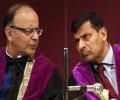
Arun Jaitley had a tough fiscal hill to climb.

It is not a good idea to take the line that since demonetisation happened in the third quarter, everything that happened then was a consequence of that, says Chief Statistician TCA Anant.

Govt has drawn list of PSUs for strategic sale: Jaitley

'India is ahead only of Pakistan in the amount spent on each soldier a year.' 'The Indian military is a manpower-heavy throng that is poorly armed, equipped, and trained,' observes Ajai Shukla.

Watal a 1978-batch Andhra Pradesh cadre IAS officer.
S&P Global Ratings on Tuesday raised India's growth projection for the current fiscal to -7.7 per cent from -9 per cent estimated earlier on rising demand and falling COVID infection rates. "Rising demand and falling infection rates have tempered our expectation of COVID's hit on the Indian economy. S&P Global Ratings has revised real GDP growth to negative 7.7 per cent for the year ending March 2021, from negative 9 per cent previously," S&P said in a statement. The US-based rating agency said its revision in growth forecast reflects a faster-than-expected recovery in the quarter through September. For the next fiscal, it projected India's growth to rebound to 10 per cent.

More than 3,71,500 babies were born worldwide on New Year's Day and India is estimated to have recorded the highest number of births at around 60,000, according to the United Nations' children's agency.
